Advanced Topics
QR Codes vs NFC Tags
Both connect a physical object to a web page, and the comparison usually gets framed as old versus new. That's the wrong axis. The real difference is range — a QR code works from across a room, an NFC tag requires physical contact — and almost every other trade-off follows from it. Choose based on how far away the person will be, and the rest mostly decides itself.
The short version
- Range is the deciding factor. NFC needs under 4 cm; QR works from 10 cm to several metres.
- QR is free — it's ink. NFC has a per-unit hardware cost.
- QR works from a photo or a screen. NFC can't be relayed at all, which is a security advantage.
- NFC feels better at close range: tap, no aiming, works in the dark.
- Device support favours QR for the long tail of older and budget phones.
- Using both is common and often correct — they cost almost nothing together.
The difference that matters
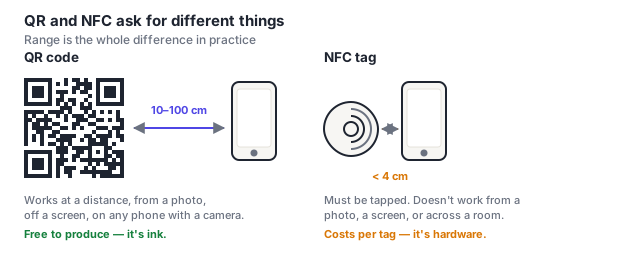
NFC operates at 13.56 MHz over a few centimetres — in practice, touching distance. That's not a limitation to engineer around; it's what the technology is. A QR code is read optically, so it works at whatever distance the code is large enough to resolve, from a business card at 20 cm to a billboard at 50 m.
Which means the question isn't "which is better," it's "will the person be touching the thing?" A museum label they lean into, a payment terminal, a product in their hand — NFC is available. A poster, a shop window, a table across the room, a slide on a screen — NFC is simply not an option.
The comparison, honestly
| QR code | NFC tag | |
|---|---|---|
| Range | 10 cm – several metres | Under 4 cm |
| Unit cost | Zero — it's ink | Cents to tens of cents per tag |
| Works from a photo or screen | Yes | No |
| Interaction | Open camera, aim, tap notification | Tap. No aiming, works in the dark |
| Device support | Any phone with a camera | Most modern phones; patchier on budget/older |
| Visible | Yes — takes design space | Can be hidden inside an object |
| Survives dirt and wear | Up to ~30% damage via error correction | Immune to surface damage |
| Survives bending / heat | Fine — it's printed | Antenna can be destroyed |
| Works on metal / liquid | Yes | Needs special tags |
| Can be copied by photo | Yes | No |
| Can be tampered with a sticker | Yes — a known attack | Harder, but possible |
| Rewritable in place | No (use a dynamic code) | Yes, physically |
| Data capacity | Up to ~3 KB | Typically 48 bytes – 8 KB |
Where NFC genuinely wins
Worth stating plainly, because a QR-focused site has an obvious bias:
- The interaction is nicer at touching distance. No camera app, no aiming, no framing, works in complete darkness and for people who find aiming a camera awkward. For a repeated daily action this matters.
- It can be invisible. A tag embedded inside a product, under a label, or behind a poster preserves a design that a QR code would interrupt. For luxury packaging this is often decisive.
- It can't be relayed. You cannot photograph an NFC tag and send it to someone. For access control, authenticity and ticketing that's a real security property — a QR ticket is a screenshot away from being shared.
- It's rewritable in place. A physical tag can be reprogrammed without reprinting anything. A QR code needs a dynamic redirect to achieve the same effect.
- It survives surface contamination. Grease, paint or dirt over the tag doesn't matter — there's nothing optical to obscure.
The counterweight is cost and reach: a tag costs money per unit and won't work for a meaningful share of phones, while a printed code costs nothing and works for essentially all of them.
Choosing
| Situation | Use | Why |
|---|---|---|
| Poster, window, signage | QR | NFC can't reach |
| Restaurant table, menu | QR | Scanned while seated, not touching |
| Printed material of any kind | QR | Ink is free; tags aren't |
| Business card | Either | NFC feels premium; QR is universal |
| Museum or exhibit label | Both | NFC for the tap, QR for anyone whose phone lacks it |
| Product authentication | NFC | Can't be photocopied |
| Access control / ticketing | NFC | Can't be screenshotted and shared |
| Luxury packaging | NFC | Invisible; preserves the design |
| Mass-market packaging | QR | Per-unit cost at volume |
| Anything on a screen | QR | NFC cannot work from a display |
Where NFC makes sense, adding a QR code alongside costs nothing — it's already printed material. The tag serves people whose phones support it and who are standing close; the code catches everyone else, including anyone photographing it to come back to later. Museums, product labels and premium packaging routinely do both, and it's a strictly better outcome than picking one and excluding part of your audience.
Practical notes if you use NFC
- Test on real devices, both platforms. Behaviour differs — iPhones handle background tag reading differently from Android, and some phones need the screen unlocked.
- Mark where to tap. An invisible tag is invisible; people don't know where to hold the phone. A printed symbol solves it.
- Use on-metal tags near metal or liquid. Standard tags fail badly against both.
- Consider locking the tag once programmed, so it can't be rewritten by a passer-by with a phone.
- Budget per unit at volume. Cents per tag is nothing at 100 and material at 500,000.
And if the tag points at a URL you might want to change later, put a dynamic redirect behind it for the same reason you would with a QR code — reprogramming a tag in the field is far harder than repointing a URL.
Frequently asked questions
Is NFC better than QR codes?
Neither is better in general — they solve the problem at different distances. NFC needs the phone within about 4 cm, so it's only an option where the person will be touching the object. QR works from 10 cm to several metres, which covers posters, signage, screens and tables. NFC has the nicer interaction at close range; QR has zero unit cost and works on essentially every phone.
Are QR codes obsolete now that NFC exists?
No, and the range difference is why. NFC has existed in phones for over a decade and hasn't displaced QR codes because it physically cannot do most of what they do: it can't be read from a poster across a room, from a screen, or from a photograph. It also costs money per unit where a printed code costs nothing. They're complementary rather than successive.
Can NFC tags be used on posters or signs?
Only if people will walk up and touch the poster, which mostly they won't. A tag on a poster requires the reader to be within a few centimetres, so it fails for anyone reading from a normal viewing distance. If the poster is at a bus stop or in a corridor, a QR code is the only option that works — though there's no harm in having both if the poster is somewhere people can reach.
Which is more secure, QR or NFC?
NFC, in one specific and important way: it can't be relayed. You cannot photograph a tag and send it to someone, which makes it materially better for access control, ticketing and authenticity — a QR ticket is a screenshot away from being shared. QR codes are also vulnerable to sticker-over-sticker tampering in public places. Neither is a security mechanism by itself; both just point at a destination.
Do all phones support NFC?
Most modern ones do, but support is patchier than camera support — budget and older handsets often lack it, and some phones require the screen unlocked or have background reading disabled. Every phone with a working camera can read a QR code. If reaching everyone matters, that gap is the argument for a QR code alongside any NFC tag.